How do NFC review stands work? (And are Google review cards legit?)
An NFC review stand holds a passive chip that opens your Google review link when a phone touches it. How the tap works, what it costs, and which ones are legit.
By Shortfield 5 min read
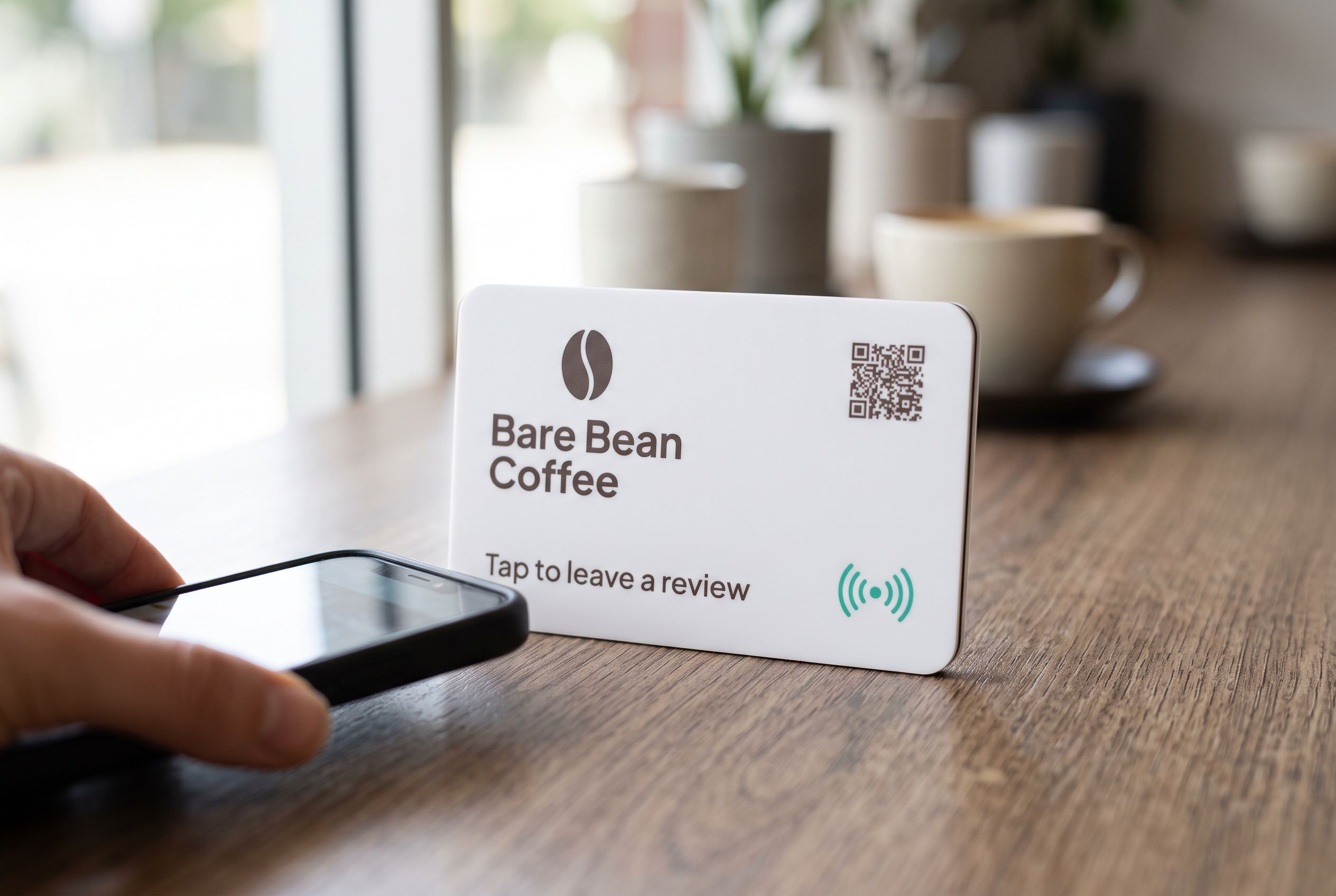
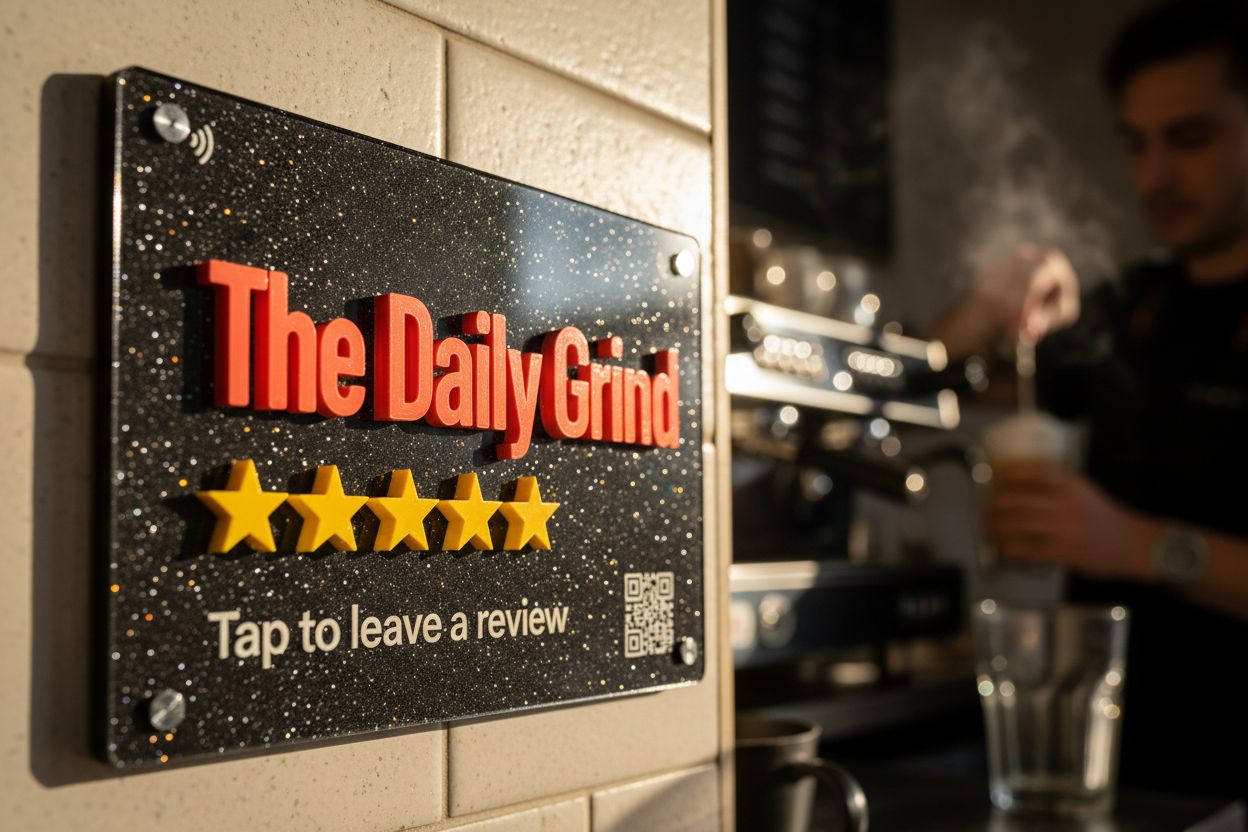
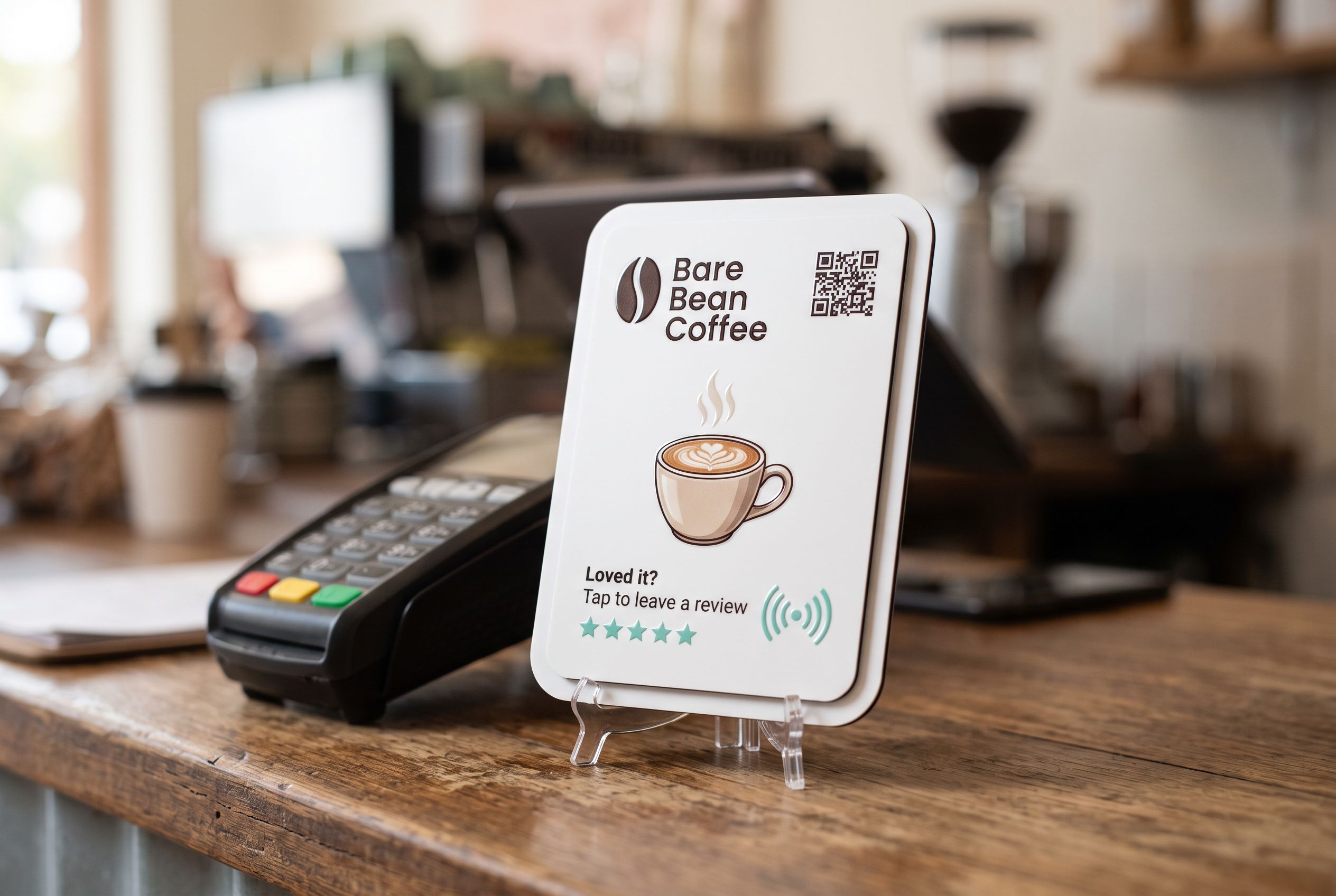
An NFC review stand works by holding a small passive chip that stores one web address: your Google review link. When a customer holds their phone near it, the phone’s NFC reader powers the chip for a split second, reads the address and offers to open it. The customer taps the notification, Google’s review form opens with the stars showing, and they leave a review. There is no app, no battery and no pairing. Most stands also carry a QR code pointing at the same link for phones that cannot tap.
That is the whole trick. The rest of this guide covers what is inside, what the customer sees, and how to tell a legitimate review stand from one that will get you into trouble.
What is inside an NFC review stand?
A thin NFC chip with a coil of wire around it, called an antenna, sealed inside or behind the face of the stand. On a Shortfield tile the chip is sealed inside laser-cut acrylic or wood, so nobody can see it or pick at it. The chip has no power source of its own. It wakes up only when a phone’s reader is within a centimetre or two, which is why it never needs charging and never goes flat.
The chip holds a short web address. On a cheap generic stand, that address is often your Google review link written straight onto the chip. On a Shortfield tile, the chip holds a Shortfield address, and your account decides where that address sends people. That difference matters later, when your link changes.
What does the customer actually do?
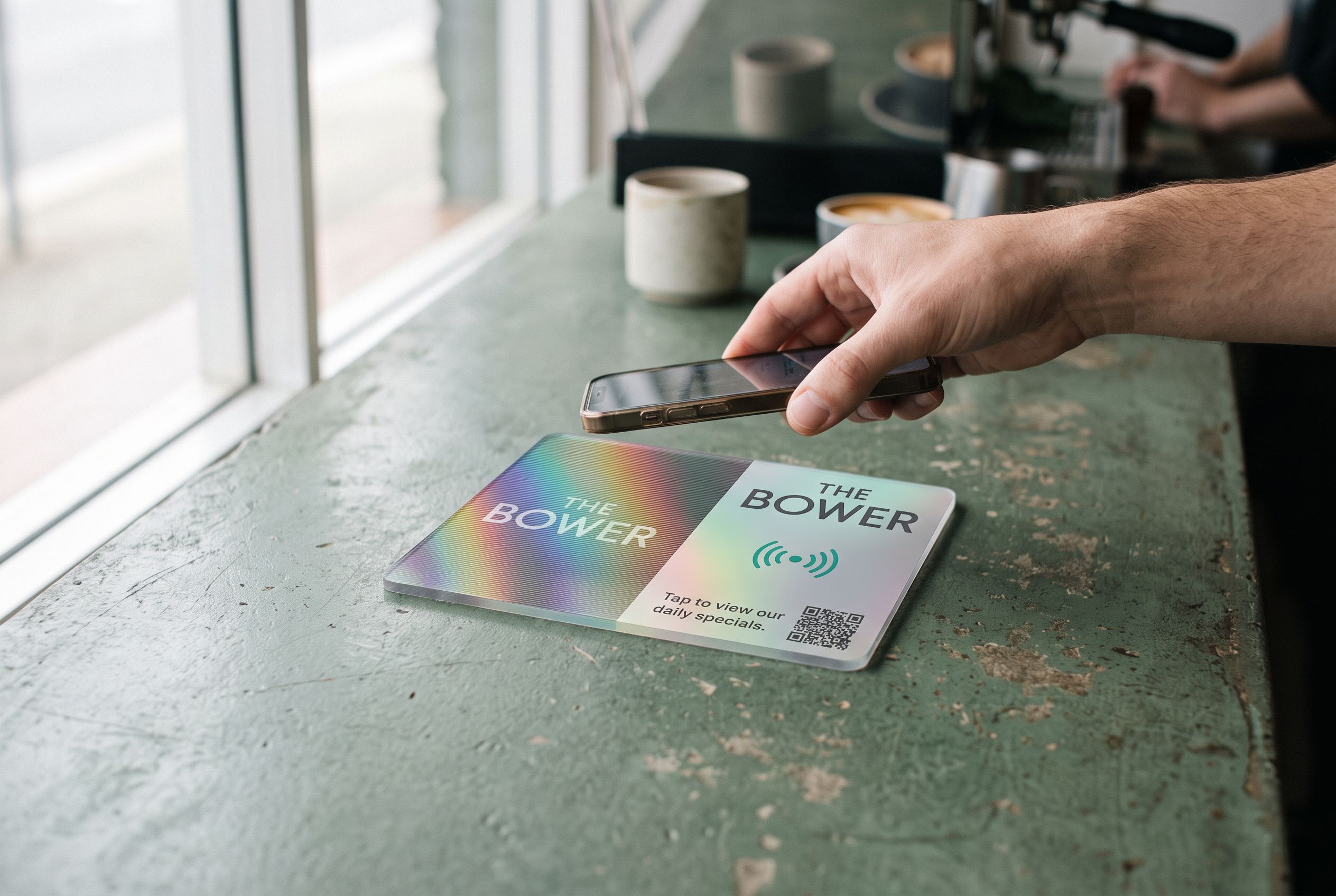
- They hold the top of an iPhone, or the back middle of most Android phones, near the stand. It works through normal phone cases.
- A banner appears on the screen within a second.
- They tap the banner and your Google review form opens in their browser or the Google Maps app.
- They pick stars, write a line if they want, and post.
Every iPhone XR and newer reads the chip from the lock screen with nothing switched on. NFC-equipped Android phones do the same when NFC is on, which it usually is. Anyone else scans the QR code on the face. For the model-by-model detail, see which phones can tap NFC tiles.
Does the stand need Wi-Fi, Bluetooth or power?
No. The stand needs nothing. The customer’s phone needs mobile data or Wi-Fi to load the review page, the same as it would for any website. If your shop has poor reception, customers can still tap; the page just loads slowly. Offering guest Wi-Fi helps, and you can put that behind a tile too.
Are Google review cards and stands legit?
The technology is legit. NFC is the same standard behind contactless card payments, and a stand that opens your review link is simply a faster way of asking. Google allows businesses to ask customers for reviews and provides the review link for exactly this purpose, under “Ask for reviews” or “Get more reviews” in your Google Business Profile. Our guide on how to get your Google review link walks through it.
What makes a review stand illegitimate is how it is used, and occasionally how it is sold:
- Anything that filters customers. Some products send the customer to a “how did we do?” screen first, and only pass happy customers on to Google while routing unhappy ones to a private form. That is review gating, and it is against Google’s policies. In Australia the ACCC treats selectively solicited reviews as potentially misleading under Australian Consumer Law. See Google review rules in Australia.
- Anything with a reward attached. A stand that says “Leave a 5-star review for a free coffee” breaks Google’s rules against incentives, whatever the technology.
- Claims that it “guarantees” 5-star reviews. It does not. It makes leaving a review easy for everyone, happy or not.
A legitimate stand opens your real Google review form for anyone who taps it. That is all it should do.
Why does a tap work better than asking?
Asking someone to “find us on Google and leave a review” gives them four or five steps to do later, and later rarely comes. A tap turns it into one gesture they already make at the terminal to pay. The ask happens while they are still standing at the counter, which is when they are most willing. Staff saying one line (“If you enjoyed it, tap your phone there”) does more than any sign.
What happens if my review link changes?
This is where stands differ. If the Google link is written straight onto the chip and your business moves, merges listings or rebrands, the stand keeps sending people to the old place and has to be thrown out or rewritten.
A Shortfield tile points at a Shortfield address. You change the destination in your account and every tile follows, with nothing reprinted or reprogrammed. The same tile can go from your Google review form to your Facebook page for a month and back again. The free Basic account covers this for any number of tiles, along with tap counts, so you can see whether the stand is being used.
How much does an NFC review stand cost?
Shortfield tiles run from $39 to $430 per tile in AUD including GST, depending on material, finish, size and print. There is no subscription required. You see the tile fully rendered in the online designer before you buy, and it is made to order in Australia and delivered to every state and territory. The Google review stand page shows the counter version; the Google review tile is where you design one.
Frequently asked
Do customers need to download anything? No. Reading an NFC tag is built into the phone, and the review form is Google’s own page.
Can the stand see who left a review? No. The chip only hands over a web address. Your account shows how many times each tile was tapped, not who tapped it or what they wrote.
Does it work through a glass counter or window? It reads through phone cases and standard shopfront glass. A thick glass slab between tile and phone can put it out of range, so sit the tile on top.
Is an NFC review card the same thing? Same chip, different shape. Cards are carried and handed over; stands sit where customers pay. The trade-offs are in NFC review cards vs stands vs plaques.